
Lee Sends: Old School vs. GWOT: Comparison + My Comment
Lee wrote this on the FORUM HERE:
This is being written as an adjunct to Max’s blog post,
MVT Tactical Training: Perspective
First a disclaimer, this is being written in reference to the average rifleman, the everyday combat grunt. The observations herein do not include any specialized or advanced unit such as sniper teams, recon platoons, SF etc. etc. etc. It is the everyday basic U.S. grunt. That means Army and Marines. (I swear if I hear another Airforce Security Forces shmuck utter the word infantry…)
I served nearly 4 years as a basic rifleman before moving on to bigger missions with smaller units. One of the things that I have noticed is a severe difference in the training that I received, as opposed to older family members that served in the infantry during previous wars.
As a child, I was exposed to (in some cases “taught”) the experiences of family members who served in WWII, Korea, and Vietnam, and the Gulf War. Every one of them as infantry of some sort. (Two rifleman, a mortarman, and a machinegunner). Unlike many of the fighting men of those generations, these family members believed it was important to pass the true stories on to the next generation so that mistakes would not be repeated. I was the beneficiary of that rather unique thought process amongst the older veterans.
After completing Marine School of Infantry (SOI) in 2002, I noticed a huge difference between the training that all these other Infantrymen received, and what I got. How were they different?
WWII and Korea had a heavy, heavy focus on long range marksmanship. It relied on rather large units (compared to the wars of today) and was very centrally controlled. Field craft was also very good, but this seemed to be more the result of a more rural society bringing in their civilian know how to the military than the training itself. However, good field craft was highly institutionalized and encouraged.
In Vietnam, we saw Marksmanship take a huge hit. The jungle warfare found in the majority of the country led to the U.S. military adopting a “spray and pray” tactic everytime contact was made. This, more than anything led to the adoption of the 5.56 over the 7.62×51 round. Simple carrying capacity. Field craft remained decent, although with the large amount of unmotivated conscripts, it seems this is where field craft began to fall to the wayside also. WWII had it’s draftees too, but it was a different animal completely.
The GWOT however we saw some extreme changes. Long range marksmanship is all but forgotten. Perhaps not totally in the USMC where recruits were still qualifying at 500m with iron sights at least up until 2012. But then again in SOI, it is all but forgotten in favor of close quarters marksmanship. The close quarters marksmanship has led to outstandingly improved weapon manipulation over the old school. But this loss of long range marksmanship however has very likely cost lives in Afghanistan where most SAF fire initiated by the enemy was in the neighborhood of 400m away…
Simple packing of a ruck and long range foot patrolling has fallen by the wayside. Troops are largely vehicle mobile in the GWOT, and basic field craft is all but non-existent. I see this happening for two reasons. 1) An increasingly urban U.S. population that sees a significant loss in hunting participation on a YEARLY basis and 2) Atrocious field craft training for the average Grunt, which is deemed unnecessary anyway since the GWOT is an “urban” fight. (Which is complete bullshit by the way…)
Small unit tactics has become a premium however. Only in the GWOT have we seen such large numbers of Grunt squads (9 to 13 troops) operating independently and at times completely unsupported. This has also led into an increase in the decentralization of command. With such small units operating without direct control or supervision by higher command. The “strategic corporal” concept comes to mind. Never before had so much command responsibility and heavy decision making rested on a non-commissioned officer in the infantry. Sergeants and Corporals are very decisive, aggressive and exercise far more initiative today than ever before.
At MVT we have noticed what works and what doesn’t in combat. Who did shit better? The old school guys or these new GWOT kids? The truth as demonstrated in combat is that the “best” is found in a combination of both worlds.
The Old School
Field Craft (Forage, camouflage, entrenchment, survival skills etc.)
Long range and intermediate range Marksmanship
Long range foot patrolling
Company and platoon sized operations
The GWOT
Weapon Manipulation
Close quarters Tactics
Small Unit Tactics
Individual Initiative (not reliant on orders from higher, tactical and strategic thinkers)
Mobility Tactics (vehicles, perhaps not all that applicable for most tactical civilians…)
Combat Trauma Care
Perhaps this is not an all inclusive list. But it does give one some idea of the differences in the training coming from someone with an extensive family history of infantry service who served in the GWOT.
In forum comments, Lee also adds a very important factor that has been improved in recent times: Medical (i.e. TC3 etc.)
How does this relate to training?
As commenters have said on the forum, this is an excellent analysis and it also shows something that we have been doing at MVT – combining the best approaches, although so far I have not summarized it as well as Lee did above. Somewhere between the square range ‘tacticoolers’ and the ‘FM readers’ of the black boot army era, is what we have been doing at MVT, and what I have been attempting to describe when I tell people what my plan was when writing ‘Contact‘ and what we bring at MVT training.
Where do the standing, close range, square range adherents go wrong? They are focusing on limited weapons manipulation and not taking account of Small Unit Tactics (SUT), fieldcraft, cover etc. They have taken (or instructors are only teaching) the improvements to weapons manipulation training that we see with the GWOT, and close quarters combat, and simply stuck with that.
Where do the ‘Old School Only’ guys go wrong? They are not taking account of the close combat and weapons manipulation improvements from the recent GWOT.
I have been saying this for a long time, only not as well as the post above. Well done Lee.
If you look at the MVT class list of realistic live fire training, you will see we have this covered:
Civilian Close Combat: square range weapons manipulation, including CQB, react to contact drills, and also use of/firing from cover, barricades, basic buddy pair fire and movement. Everything you need at a fundamental level to fight in and around your suburban neighborhood.
Combat Team Tactics: Individual weapons manipulation and react to contact drills, beginning with day 1 on the square range with combat rifle, then moving to two days on the tactical ranges for fire and movement and break contact up to team level, including a finale guided squad attack.
Combat Patrol: SUT at team and squad level covering the essentials of patrol operations: patrol base, movement, recce patrol, ambush patrol, security patrolling and raid. This is both a low tech and high tech class, aimed at those with or without night vision equipment, and allowing for both approaches.
Night Firing: NODF covers use of modern NVGs/Lasers and includes live firing drills on the square rage followed by a controlled night raid on an objective (scenario based).
Land Navigation: old school navigation techniques (orienteering based) covering low tech navigation. Take the patrol to the right place!
I have a somewhat nuanced comment on an element of the above post, however. It is concerning SUT and the GWOT. Lee states that a strength of the Old School is Company and platoon sized operations. Agreed. He also lists a strength of the GWOT as Small Unit Tactics. Somewhat disagree, with a nuance. Remember, the premise of Lees article is that we are dealing with ‘ordinary units’ not anything ‘special.’
Why do I have a nuanced disagreement with the Small Unit Tactics statement?
It is my opinion that although we have seen development of independent command down to lower levels as part of the GWOT, and we have the rise of what could be called the ‘strategic squad leader,’ there are some issues with this. I think the art of SUT has somewhat been lost during the GWOT, possibly due to FOB based operations and a lot of vehicle based operations. Also, due to the availability of close air support / support fires much of the time a lone squad / detached element under fire will not conduct SUT, but will ‘call for fire.’ And why not, of course? The point is not to conduct SUT for the sake of it. The point is to win.
So although there may be increased responsibility down to lower levels of command, I think that does not necessarily come with greater ability to conduct SUT. I have not been impressed by what I have seen of SUT ability across the ‘normal’ or ‘ordinary’ US Military. And of course, even SOF units may have lost this to some extent as part of the GWOT. By way of anecdotal example, Ranger school is an excellent leadership school using SUT as a vehicle for leadership training. However, I have been the recipient of comments by Rangers serving in the Ranger Battalions that Ranger School is increasingly irrelevant and after it “guys have to be retrained at Battalion in SOPs” (remember that new Rangers do not do Ranger School, that will come later, they will come through Ranger selection). Although I disagree that Ranger School is now irrelevant, because I am champion of the sort of SUT taught at Ranger School, I understand why this comment was made: the role of the Ranger Battalions throughout the GWOT has been as an SOF raid force conducting an overwhelming amount of CQB based short term operations, i.e. kill or capture, usually into a building or compound objective, with high mission turn around and perhaps multiple objectives per night. This is the modern close combat / CQB/ weapons manipulation / night vision high speed stuff referred to in Lee’s post.
Another thing we need to consider is that although there may be more independently operating smaller elements, such as squad level, in the GWOT, we also have massive advances in communication and surveillance technology. Combined with rules of engagement, what you have increasingly in the GWOT is micro-management from back at the TOC, at often obscenely higher levels of command. So although that squad may be out on its own, it may be having its strings jerked about by higher. This is a corruption and failure of the concept of mission-command.
I also think that because part of the training towards good SUT in platoon and company operations is the individual, team and squad training that is the building blocks; and thus, before you do platoon attacks, you do squad attacks. True, in ‘old school’ a squad leader may not have been given as much independence as a GWOT squad leader may be given, and thus would perhaps have less chance to utilize these skills. Also, part of this is that when you are involved in bigger wars, you tend to act as bigger units, as platoons or companies, with the company really being the smallest independent element in a large scale war. In a company in the attack, there is less freedom of movement for individual squads. Such is true when you examine large attacks in the Second World War, for example. These often took the form of advances over several kilometers, as part of a set piece objective, with a large volume of indirect and direct fire going in both directions, and the infantry force ‘winning’ being the one that did (or alternatively didn’t) make it onto the objective. I summarize and generalize, but I hope you see my point.
I am currently reading an excellent book: ‘With the Jocks‘ by Peter White. It is a moving account of his part in the war as a platoon commander with a Scottish Regiment from the Fall of 1944 to the end of the war. He loses his platoon in its entirety throughout this time, to wounds and death. True, there is much of the set-piece battle and limited freedom of maneuver at platoon level in the book; howling industrial warfare firestorms of artillery, mortar and 88mm fire etc. But even evident in the book is SUT. Here is small excerpt to illustrate this:
….sent Sgt Cowie out on a recce patrol to see if the house was clear of enemy. He was to take a section of men with him, and one of the only two 38 sets then still working to keep in touch. He was to work around in a dog’s leg, coming in to the house at right angles from us so that if he ran into trouble we could give him covering fire. (90 degree angle seem familiar to CTT/CP alumni?) At the angle of the leg of his route stood two small farms which he would have to clear too. Getting to the farms involved a lengthy stalk along the side of a water filled ditch called Ekklesen Beek. He wisely chose to keep off the track for fear of more mines, and reported the farms clear by radio as he passed them. As the distant figures of the patrol approached the house, we trained our weapons on it, and watched intently the jerky movements of the Jocks working their way towards it in bounds. (bounding overwatch anyone?) They disappeared inside with no sounds of firing coming back…….(well, that was high threat room entry and clearance, but they could probably have used contemporary tips from the GWOT on best practice there….)
One of the things that I believe is inaccurate are people’s impressions, often gained primarily from Hollywood and not historical study, of the tactical ability and reality of some of these battles in WW1 and WW2. They just used to walk towards the enemy in the trenches of WW1 right? Yes, that did happen, but many times it didn’t, in particular from some of the Regular Army battalions with training and experience fighting there. Often, bounding of platoons in individual sections was used to try and cross no-mans land. Now, that still didn’t always work, perhaps if the artillery barrage was not effectively suppressing the enemy on the other side of no-mans land. But often it was for reasons that you may not be aware of.
I have a historical anecdote in my mind that I know is not exactly accurate, but it is something like this: during a WW1 trench attack, a platoon was moving forwards, bounding by sections. The platoon commander looked to his rear to call the next bound, and saw all his men laying down. He was about to swear at them as ‘cowardly bastards’ when his platoon sergeant, wounded, in a final effort looked up and said something like: “No Sir, they are all dead.” The attack was over, despite use of bounds.
Because it’s not the Hollywood image of the German machine gun on the trench parapet 100 yards away that is the threat. Back then, the art of machine-gunnery was alive. There are numerous instances in WW1 of Battalions, knowing that if a machine-gun on the corner of a wood was not destroyed, knowing that they would be wiped out, or at least suffer heavily, in an attack. So, it’s easy to wipe out a machine-gun, right? Just plaster it with artillery fire till it goes away? However, particularly in the chalk areas (Somme battlefield) of the Western Front, the Germans would tunnel in and dig bunkers underground. They would then open up a small foot wide aperture in the front of the chalk/bunker. This machine gun would not be firing to the front, but it would be a sled-mounted water-cooled MG-08 firing at the cyclic rate (500 rounds per minute) in enfilade across the line of no-mans land 1000 yards away or greater. The machine-gun that is killing you is not even in the same grid square as you.
Ask the men of the Devonshire Regiment, which was almost wiped out on the first day of the Somme. 163 of the dead were retrieved from where they fell in no-mans land and buried in the trench from which they had ‘gone over the top.’ The famous saying is: “The Devonshire’s held this trench. They hold it still.”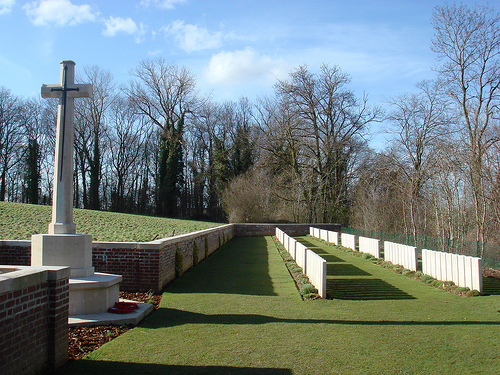
“The Devonshire’s held this trench. They hold it still.”
So, I digress. My point is that SUT was not absent in these wars. There was more of it than you may realize. Also, the now famous German ‘Stormtrooper tactics’ which they apparently invented in 1917 to break the stalemate on the Western Front, consisting of SUT based fire & movement, short rushes etc, came about because they got their hands on the British Army Infantry Manual of the time and trained in it.
But it’s a hard thing to nail down. We can talk about ‘Old School’ and ‘GWOT’ but there is such a vast difference of experience across the GWOT. It can be anything from being a road warrior to fighting at company-, platoon-, section (squad)-level old school infantry operations in places such as the green zone of Helmand, or more desert based such as manning the compounds, and patrolling from them, in Garmsir to the south. or the wadi- and mountain- desert- based locations such as Kajaki and Musa Qala. And these can get down and dirty just like any war of the past, and are more than likely not getting micro-managed at close range in the jungle-like vegetation of the green zone, and may not always be resolved with a ‘call for fire.’
And now for another slight digression from the main topic: as a former anti-tank officer in 2 PARA, I was aware of current British army machine-gunnery. Being an anti-tank officer in the (Fire) Support Company made you the Battalion Commander’s anti-armor adviser. Now, in deployment on current day operations that normally meant command of ‘MSGs’ (maneuver support groups) which would combine vehicles carrying anti-tank weaponry with others carrying machine-guns. This was a joint tasking where the MSGs were formed from elements of the anti-tank and machine-gun platoons. However, I was in conversation with Chris at a class and I mentioned the art of ‘sustained fire’ (SF) machine gunnery. This is where a GPMG (i.e. 240) is mounted on a tripod (not the light tripod with T&E used by the US Army) and laid and fired on pre-registered targets using a C2 sight and aiming post just like an 81mm mortar. This works out to 1800 meters and there is also map-predicted fire out to 2500-3000 meters. The gun is not fired in the shoulder, in fact it is just fired with the finger and thumb, and the rounds impact a cigar shaped ‘beaten zone’ a little like my example of the German MG-08 (although the GPMG is not water cooled, and barrels have to be changed out).
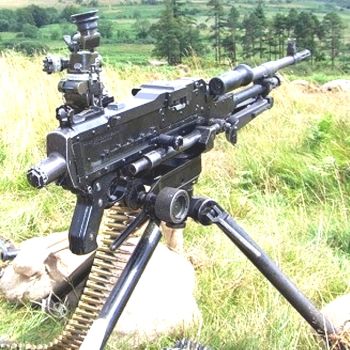
GPMG SF Role with c2 sight: aiming post not shown. Note replacement of the machine-gun butt with butt plate.
Chris was all over me about this. I thought he was jerking my chain at first, but apparently this is not taught in the US Army, at least widely. I am sure 18B SF weapons guys must know about this? Anyone? Chris was adamant how this employment of the 240 in a defensive fire (DF) role could really have helped some of these poorly sited (low ground) FOB/COP locations in Afghanistan.
As a one-time anti-tank officer, what was very interesting was the ‘TESEX’ which was run on Salisbury Plain training area. This utilized MILES gear and was a Battalion level FTX. They have an actual armored Battlegroup that is designated as the OPFOR;it is the job for that Battlegroup for a whole 2 year posting. As an anti-tank officer, as part of an unarmored light infantry Parachute Battalion, this allows you to do your actual job, as in if the Soviets were coming through the Fulda gap (Ukraine anyone?) It is pure maneuver warfare, with the OPFOR doing what they want. As one phase of this operation we parachuted in and secured a village, digging in around it. The use of MILES gear is as realistic as these exercises can get. At the end of the operation, I recall our two forward companies (dug in), had been destroyed and the enemy was through my anti-armor defenses (maybe I should have been better at my job?) We had notionally destroyed the bridge and the enemy armor was maneuvering with a bridging tank to put a bailey bridge across the defile. I remember running to the bridge with the support company commander and some remaining soldiers carrying LAW missiles (like the AT4). As one of my platoon shouldered the LAW, he was ‘shot’ (started bleeping). I managed to salvage the situation by then picking up the LAW and ‘destroying’ the bridging tank, thus preventing the enemy getting across. It is this sort of fighting that we are not currently focused on and which is not part of the GWOT experience. Unless we get back to this, once we finally manage to provoke Russia to war, we will have a hard time of it. Read that book ‘With the Jocks’ and consider the stories he relates of enemy massed artillery fire. That kind of capability, which the Russians have, would really ruin the Baskin Robbins counter back in the FOB DFAC. Oh, you won’t have a FOB, because you will be engaged in running maneuver warfare armored battles….ooops….Russian tanks just rolled through the MWR tent….
Max
Yeah I remember this conversation, when you shoulda got the VC for your actions.
All good points, especially about the Super squad leader, versus the micro-management.
Suffice it to say, we probably won’t have these worries at our level.
I don’t know why it’s SO HARD for people to pick the best practices, for your own use, versus clinging to the total package, of what you, or someone else was taught, circa whatever. Is it that hard to connect the fucking dots?
Its just my opinion but a collapse (any collapse and the disorder it brings) is a collapse and as such everything will fall and fail. This includes all the plans we all have made that we think will save the day. I dont exclude myself from this inconvenient truth. The only sure action I know I can count on taking on is getting the fuk out the area and surviving to see whats next. It applies to any collapse in my area, even invasion. Escape-Evade-Survive and look at whats next. I dont have a crystal ball and Doc Brown didn’t give me a Delorean. With that being said Id rather be flexible and leave myself with options then corner myself into one train of expectations that later i have to take time and resources to rebuild when they dont pan out. If i dont escape its because I’m dead. As training goes id rather be a jack of a many skills sets then just a master of one. Its what my situation calls for. Its all i have time for and i think many have this same issue. Just like most ppl time and money are the road blocks to ultimate success.
Plans are not the only things that will fail. High-tech electronic items right down to re-curve bows looted from high-school gym lockers will fail when parts and batteries are no longer there to keep them going. This will surely fuk up strategies and tactics and what ppl think they will have to do to survive. The GPS addicts will be fuked..Cabelas will be closed and UPS wont be delivering. If there is hard fighting this rape of resources will not take long. Then you will really be left using what you have, not what you wish you had.
Unless someone has thoroughly examined where they are and the endless possibilities of the OPFOR and rules/terms of survival they will be handed-they just dont know and probably wont till its too late. A good guess is what most will have. To simply think and plan to automatically be a rifleman in an organized unit and be located where this sort of unit is applicable is fool hearty. Just as fool hearty as thinking you’ll be safe buried in some hole with all the luxuries of a pre-collapse life and never do any rifleman training for such a situation. Or maybe as fool hearty as me thinking I can escape out of here and live in the mnts. It will be a new world and we will have to adapt to the hand we are dealt.
What will we face? There will be room for expecting everything-because everything that can be pulled from the rubble and used, will be used to the fullest extent of human fury. You will see some that will acquire AT-4s, RPGs, tanks, Hummers, bank armored trucks, abandoned police armored trucks, gangs on horses and mini guns while others will be building gigantic Romanesque cross-bow type launchers in their garage that will take out a pick-up truck. We’ll probably even see catapults and the resurrection of siege warfare for some of these “survival compounds” and neighborhood hold up points in certain areas.. You will have guys kitted with the latest night-vision and thermal kit while other have nothing but a hammer and a Bic lighter. All skill sets will be validated and tested for what they really are..
What will play another huge factor is location, climate and terrain and the enemy you’ll be dealing with in that area. There is no cookie cutter solution, groups or plan for any of us in knowing what to expect and what we will need to survive or where we will end up operating. From one town to the next the situation can and will be vastly varied. In some areas a Rifleman approach in an organized unit will be in order while in others you may have to form an underground resistance against the inevitable rise of local war lord and gangs, Or perhaps against an occupation army where actual fighting will be a small portion of the campaign against such groups.
I think its import for all individuals to think about their distinct individual situations, the solutions and the possibilities they face and the resources to have to plan around. You may have the best fighting kit, state of the art optics and imaging but it wont keep you warm at night and food in your belly and force multiplying weapons and kit will only multiply your effectiveness so far. What about the family unit during all this? Hungry screaming kids only scream louder if you try to feed them a MOLLE pouch..
<>
This is all good stuff above.. But what about self preservation medicine? The truth is most ppl will be alone or in very small unorganized groups and only able to care for themselves to a certain point if they are seriously hurt. My med kit fits inside of a survival tin except for a few compression bandages here and there. Alone, there is only so much i can do. Anything requiring another persons care is a death sentence. People need to understand and prepare themselves for this and not waste time and energy packing an entire EMT kit they could never use on themselves anyhow. Its an illusion…
I have always been of the thinking that planing from the bottom up is best. Eg: If all i have is a stick, and if i find a rifle-things just got better. Battery gadgets are good but are just a luxury that will fade with time. I know what the suck of it feels like. Being of limited means has definitely given me a view of what starting from and existing the bottom is like, what it takes and how to cope. I could never buy luxury or the best. Ive made do with what I had to get the job done…
Think outside the box.
Ok my mad rambling is over.. I’m going to go water my beard and walk it. That is all..
Bergmann
https://youtu.be/e4Q-lUX4QNg
Bergman,
I hear ya. The only thing we can try to do is prepare as best we can. I have no illusions that whatever kind of “event” it is, it will suck massively. And most people, as you have said, will not be prepared at all for what is going to happen. They think that they will be able to sit at their retreat and eat out of a bag and pick off anybody that comes within sniper range. They wont last long.
Is your site completely down? I have tried logging on and can’t get in.
Yes. Photobucket is feeding the picture hyperlinks to my site in fun house mirror fashion so all the pics look either like Sponge Bob or a Vangaug painting….. I may have to rebuild elsewhere..
Bergmann
West Point (black boot) video on WWI water cooled machine-guns, including some good views of enfilade and frontal live fire:
https://youtu.be/WVZczrWr2nc
My son served with 3rd brigade 3rd ID, which was heavy brigade. I remember him telling me that they would have to qualify with their 240s that were tripod mounted out to 2000 meters, I believe. Which is a different animal than a bipod mounted 240 (as your post states). A tripod allows ridiculous ranges with a 240, as my son has told me. Maybe it is because it was a tank heavy brigade. Don’t know.
Did I say bipod? Checking and correcting….
If he was qualifying out to 2000 meters, did they have a sight/aiming post with which to record DF targets? That’s the main trick of the SF system….
I will have to ask him Max on sighting system they were using. I only remember this because he was complaining that they had to get his company qualified before going to NTC and whoever scheduled the range screwed up and put them on a short range that was for bipod mounted not the longer range for tripod. Of course that’s when I asked, “what’s the difference?” And he had to explain to his civ dad. Your post reminded me of similar conversation.
You asked me about this during the last CTT. Having spent 23 years as an Infantryman, I never saw that set up for the 240B nor did I ever hear about it. And I just checked my copy of the FM for the 240, it is not listed as a component.
Max effective for area targets is 1,800 meters on the M122 tripod, max effective for point targets with M122 tripod is 800 meters. For bi-pod area targets is 800 meters and point targets is 600 meters.
As I told you, I wish we had that system, it would have made a huge difference in Afghanistan. I would have loved to have had a system like that for my M2’s during my first tour.
The art of gunnery with the MG is lost in the Army and has been for some time. That is not to say that units are not using them effectively, they just don’t know what they don’t know.
Get a copy of “A Rifleman Went to War” by Herbert W. McBride for more info on MG use during WW1.
As to tactics, I was having this discussion with I think Diz during CTT. If you could drop a WW2 Infantryman into your class, the only thing that would be different is the equipment. The tactics are the same. You proved that with the excerpt from the book you quoted.
As far as the micro management, I can only talk to my experience. While some did exist, it really depended on your unit and your location during the contact. There were times that we would report a contact and before HQ could try to do anything, it was over or events overtook what they tried to do. The biggest problem was idiots trying to second guess you after the fact. That happened all the damned time.
[…] Max adds: My follow up to JLP’s post: ‘Lee Sends: Old School vs. GWOT: Comparison + My Comment’ […]
I don’t totally understand the C2 sight being referenced, but it is now common for M240s to have M145 Elcan scopes on them. The bullet drop compensation reticle is marked out to 1200m. I know from very limited personal experience that engaging targets that far out in Kandahar province is unlikely if only because of difficulty establishing the ROE-required positive ID at that range.
The C2 sight is not a ‘sight’ in the way you refer. It is nothing to do with reticles. Best to describe It as a prismatic device that you look down into that refers to an aiming post offset into the ground. It is like a mortar sight. It allows targets to be pre registered and recorded so they can be laid into and fired onto in the dark or low visibility.
Used in that way it is very good for defensive fire. It’s not really a ‘ROE’ compatible activity which is why you have to get out of this ‘GWOT Box’ – but this would have been great if you had pre registered DFs to protect some of those FOBs that were getting attacked poorly sited in the low ground. This kind of fire can be very accurate or used to create a ‘beaten zone’ that will keep enemy off a defended position. Protect a poorly sited FOB from, for example, well sited machine guns on surrounding OPs.
I will try and give a simple and fuctional description of the C2A1/2 sight. The sight is primarily used with mortar tubes as there system to input predicted data (elevation and direction) for accurate fires. It is also used with ERMG (Extended range machine guns, also known as SFMG (Sustained fire machine guns).
The “sight” itself attaches via a bracket which itself attaches to the head of tripod that secures the MG. The basic procedure, understanding that to explain everything would take far too long is as such, Predicted data tables are used that will tell a commander the elevation the gun needs to be at to achieve an effective beaten zone (75% of the burst) on the target these tables take into c onsideration the range to target and also the position of the gun line being either above or below the target. that gives you half the answer. The second piece of information needed is a bearing (direction) to the target which the commander is responsible for calaculation using basic navigation techniques.
So effectively the commander will end up with 2 pices of information 1. An elevation or depression from his table and a bearing in Mils (different measuring system from degrees and minutes).
We finally get back to the C2 sight. These 2 pieces of information (2 x 4 digit numbers) are put into the sight, (too much detail to explain how) and a levelling bubble on the elevation dial is levelled by raising or lowering the butt of the gun and at the same time the gun is turned until the #1 sees the aiming post through the eyepice at the top (part of the detail) which ensures the weapon is pointing in the correct direction. All going well the MG should now be able to provide effective fire onto an area. There are also techniques for covering targets for width and depth and also having this fire adjusted for ultimate accuracy by foward observers.
This in no way encompasses the total process or even touches on the skill or procedures required by a skilled section or platoon but is a simplistic explaination. I hope this helps. This is my specialisation as a current serving soldier.