
MVT Shield – Field Trials
The MVT Shield project is moving forwards.
The technical/performance trials have all been completed and we are getting closer to specific production methods and exactly how the product will look.
I was out this weekend doing some field trials and snapped a couple of photos:
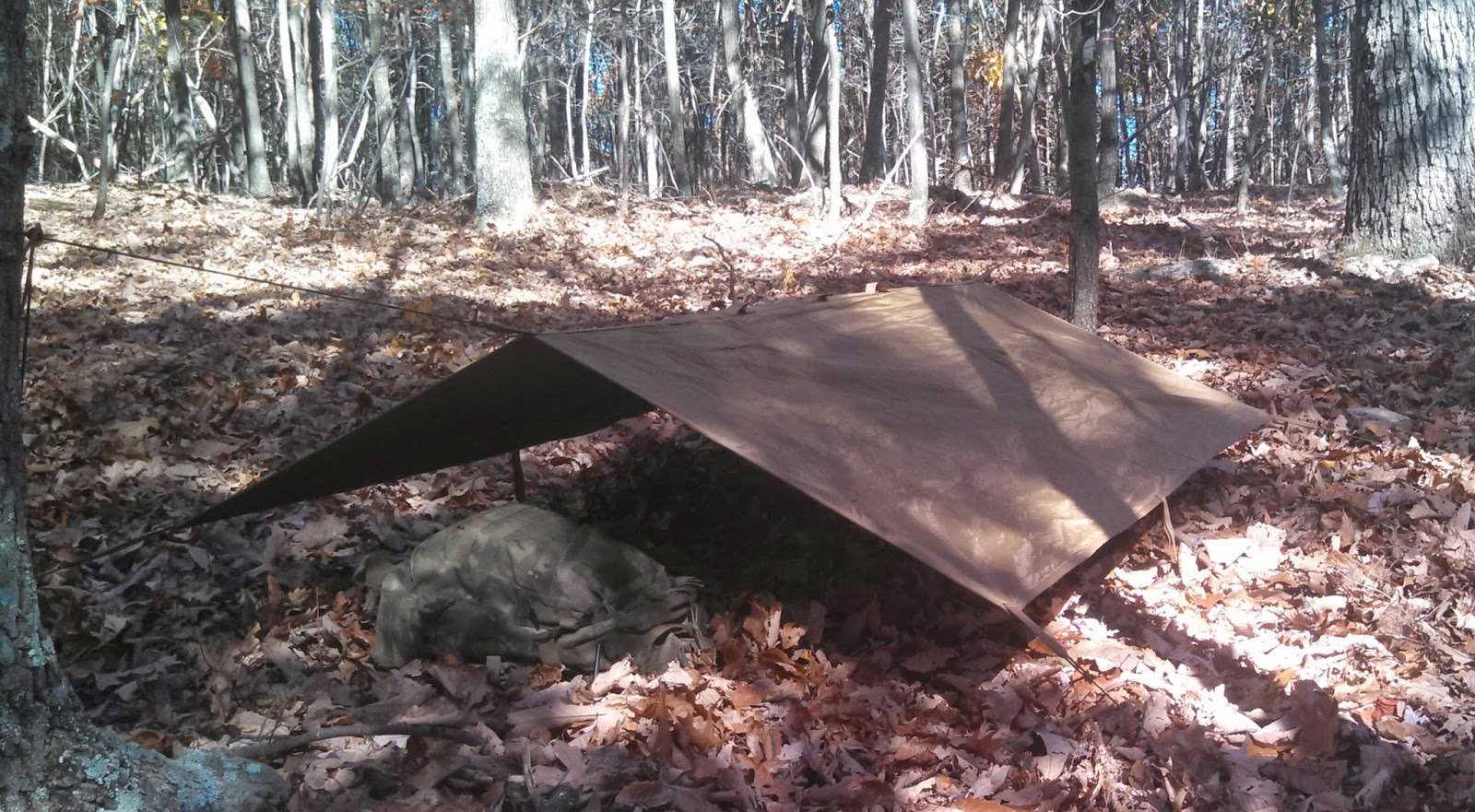

I hope the photos will bring some clarity to the concept. Previously, I think there was some misunderstanding, particularly with the use of the word ‘poncho’ – it was only ever meant as a description of the way a military poncho is used as a shelter tarp. This product is not intended to be worn, although in an emergency it can be pulled over you.
Those with experience will note that this looks exactly like a military shelter tarp. That is the point! It is designed to be used as a shelter tarp in exactly the same way, and thus be extremely useful and something you will use day to day when out in the field.
What you can’t see in the photos is the layer that will stop ALL thermal signature. Note: this is not the same as trying to use an emergency blanket. Those things state that they stop 80% of body heat – and in trials that is exactly right. They will stop 80% of body heat, so you won’t see someones body shape beneath it, but you will see the ‘thermal bloom’ across the material – that’s the 20% that gets you killed.
This product stops 100% of thermal signature, there is no thermal bloom across the material. It is slightly thicker and bulkier than a standard tarp, but not in a way where it can’t be rolled or stuffed into a pouch.
I have decided to go with the coyote brown rather than a camouflage color. There are several reasons for this: coyote will match more areas where this may be used. It is a lower profile color were someone may think you are just using a tarp, rather than something military. It can also be sprayed with krylon to better match your operating area, thus customizing the shield to the owner.
Also, I will post photos as we get closer to production of examples. This product will stop !00% of your thermal signature form being viewed/visible. You also need to take into consideration the visual signature of material through a thermal imager. All objects have a thermal signature, which is why you can make out the shapes of things like trees when viewing through FLIR. A product such as this MVT shield is best using in combination with terrain/vegetation masking. Otherwise, if used in an open field, there is a danger of an operator picking up the regular lines of the sides of the tarp.
I will show some examples where it has been ‘kryloned’ up, and also where camo netting has been judiciously applied to the edges and across parts of the center of the shield to help break up SHAPE. Thus camouflaging it in both the visual and the thermal visual sphere – typo birds with one stone. This is just part of how you will customize this product to better make it work for yourself. As an off the shelf product, it will work fine, particularly if you put it up under trees or other vegetation. For ultimate concealment, a sparsely applies camo/gillie effect will work for the SHAPE aspect of the shield.
I will post more information as we move forwards. Please don’t email me asking for prices or pre-order. I will sort all that out and put this up for sale on the website when it is ready. Announcements on the blog.
HERE is the link top previous posts with the details on this concept.
Note: this product, The MVT Shield (c), the design and concept, is patented to MVT.
Live Hard.
Die Free.
MV
Weight and folded/stored size?
I will get exact weight and folded sizes once we are closer to exact production, The tarp will be roughly 6′ x 8′. It folds up pretty much like a standard tarp that is 6′ x 8′. Exact details to follow.
LOOKING FORWARD TO PURCHASING A “FEW”. HOW LONG UNTIL THEY ARE ON SALE?
Excellent color choice and rationale!
Very good, Max. I will buy several depending on price.
I would have loved a few of these back when our scout platoon played OPFOR for OH-58Ds, and mech. infantry/armor counter-recon companies.
Accomplishing anything while hiding from those folks with nothing but terrain, vegetation, e-tools and mud is genuinely no fun.
Mr V
Coyote brown is the way to go … I’d encourage folks to go look at the ASAT [All Season All Terrain] camo before they buy their rattle cans ….
appreciate your efforts
OhioDude
Right on Max, I think CB makes the most sense for the most folks, as a good base color to start with. As an added thought, the scout/snipers in my old AO would use spray adhesive applied to the outside of the tarp and then add crumbled up sponge/foam rubber for texture. The whole thing was then krylon’d for local conditions. They originally used real dirt, sand, etc. but it got too heavy, hence the foam rubber. The added texture mimics nature better, both optically and under NIR.
Great idea. Any chance you’ll be able to take some pics demonstrating its thermal signature mitigation effectiveness?
Love the blog. Keep up the great work.
Good call on that Brown , Its probably the best base color going for a “universal” camo base. When do the supply get here and what’s the cost?—Ray
What would be the usable life span of the thermal shield? Things like weathering, spraying krylon paints on ect.Would that not result in a slow degradation over time?
SP
Shouldn’t. I’ve never seen ripstop nylon weather out. I’ve got some old tarps. And the important stuff is in the middle, protected from the weather.
I hope you get it copy righted coz someone will surely try and copy it.
SP
Will students get a shot at these before the rest of the world?
Looks good Max. Besides nylon, what materials are used in it’s construction? (If you don’t mind sharing)….
In the past I would use an air-gapped double poncho setup to create a thermal barrier – twice as much material and twice the setup time though. Look forward to testing your system…
Max,
As a former Army 18A, (and I am not playing who’s prick is bigger here, so don’t read that) I am very interested in this product of yours, but I have one suggestion I would try my best to offer a larger size if possible.
Final product will be 6′ x 8′. It’s a design proto.
As far as weathering goes, before all this Gucci gear, we used to spray paint camo our old “deuce” gear to match where we were at. If anything, the paint gave the nylon more UV pro, so it’s a plus not a minus (also reduced the shine).
How do we know it works if you don’t post a video with thermal imaging or something to that effect? For all I can tell, it is just a tarp. I love the idea, but I wouldn’t buy one without some kind of proof.
Steady there. It’s not even for sale yet. Buying is optional. When I put it up, we will see what imagery we can record/generate. But it works. I wouldn’t sell it if it didn’t. Again, if you don’t want to buy it because you think I’ll sell you snake oil, then I prefer that anyway. Thanks for you time.
When the product is ready for marketing you should have a overhead IR image to show how effective it is.
Color me stupid. That would be an overhead thermal image.
Good to see someone besides myself working on this. I have been constructing these types of positions around my AO. But mine are permanant with rocks and boulders for front and flank cover. I too have utilized the brown tarp in the process. Put me down for several of them.
panajungla1984
I’ve used 2 mylar blankets and a blanket of bubblewrap glued to a brown tarp, with pine needles and leaves glued on top for camo.
pj84
I know you can’t eliminate a heat signature of a vehicle with a bunch of tiny explosions occurring inside the engine, but could you retard it enough that it reduces the size of signature to where it could be easily over-looked?
Imagine a Jeep xj creeping through the woods with very little heat sig that gets even more subdued from the tree’s overhead..
Great job MaxV – Can not wait for the product it will save MANY in the future.
Call it a “basha.” That’s the term the Brits use.
I agree with Anon 0652 “basha” is a better term than “poncho”—Ray
I was steering clear of ‘basha’ to avoid Brit bashing! But yes, I know it as a Basha. the product is known as an MVT Shield (c), but should be used like a basha.
max, was wondering if it works when your wrapped in it.( as in a hasty situation). your if it needs an air space between you and the tarp. thanks, mthead
It does work in an emergency like this, although this is not the design concept. It also works as an emergency blanket, including for a casualty. My original concept included the air gap for maximum effect. I have not done extended trials with it in close contact with a hot body, but theoretically it should eventually heat up the material. How much ‘thermal bloom’ this will react through the heat blocking material will have to be researched – but it will work better than a standard Mylar emergency blanket that lets that 20% through..
100%? Sorry, I don’t believe it. Unless you have a Type II Perpetual Motion Machine in there. Where does the heat generated from your body go? Even if you warm the ground, it will conduct outward, and can be seen by a sensitive-enough thermal imager.
Now, could it be good enough to say, avoid detection by a drone with a standard military FLIR imager? Probably. For a few hours, at least.
You should avoid giving specs like 100% thermal blocking.
Please go back and read the previous posts on this, with the technological details. Other than that, I don’t give a flying fig if you believe it or not.
Shut up and take my money!
If you are using “MVT Shield” as a trademark (and you are), you should use the legend “TM”. You can also use (R) if the trademark has been federally registered. (C) is used for copyrights.
I get the size, but to me the important aspect is what’s the weight of the tarp?
Also getting in line for one : )
[…] I've been watching the development of the MVT Shield over at Max Velocity. I'll probably pick one up of they finish it. https://maxvelocitytactical.com/2013/…-field-trials/ […]
Max, FYI if you weren’t aware.
http://www.forbes.com/sites/williampentland/2013/12/28/nemesis-camouflage-conceals-body-heat-from-thermal-sensors/
Looks like you’ve got some competition, Max. Although, at $2,900 per suit, yours is probably the better deal.
http://www.forbes.com/sites/williampentland/2013/12/28/nemesis-camouflage-conceals-body-heat-from-thermal-sensors/
Totally different concept, and suits like this are not sustainable. They kill you from heat exhaustion. Been staying away from a suit concept.
Not attempting to argue, but I think they are taking that into account with their suit. The article mentioned intentionally allowing heat to escape, but in a blotchy pattern. My guess is that in the same way camouflage manipulates visual light by varying hue, color and saturation, they are trying to do the same with heat signature be letting some heat through and some heat retained in a natural pattern. But you’re right, I wouldn’t want to spend $2,900 on a suit that would end up making you a heat casualty in a warm climate.
But maybe there’s a concept you could apply to your tent? Have you ever thought about attempting to make the heat signature “blotchy” so to speak by building an irregular pattern/patchwork of the heat reflecting material you use? It might help break up the “squareness” of the blanket if that would show up as a big black void on a FLIR. Just some thoughts.
Any idea when these will go up for sale?
Any update on when these will be available to order? Can we preorder?
Not in the immediate future. It’s been in hold.
[…] 1) He is using just a USGI Poncho allied with a Mylar survival blanket. There are a few issues of ‘thermal bloom’ remaining. This is what my research has led me to find, and why I am using a different material/configuration in the sandwich for the MVT SHIELD. […]
Max,
Just finished reading the test results from Nicholas. Not sure if any one else has brought this to your attention, so here goes. If you were to have a single or double row of MOLLE/PALS webbing stitched on the top side of the tarp at least six inches from all edges this would cover the issue of letting the tarp hang down as Nicholas had described in his test. This would also act as a good place to add surrounding foliage to the border area of the tarp for missions that require a squad or a team to set up a good concealed OP. Just a thought. Good to know that this simple technology works well to defeat IR.
[…] I’ll have another look at this, and what is OK to publish, when I am back in on Monday. In the meantime: MVT SHIELD. […]
Better have a production line or factory to make these. Demand is going to be high.
any updates on timing of first shipments?
?
They have been shipping since August.